
Daniela Blanco
CEO & Co-Founder | Sunthetics
Hometown: Caracas, Venezuela
Alma Mater: Ph.D. and M.S. in Chemical Engineering — New York University
B.S. in Chemical Engineering — Universidad Simón Bolívar
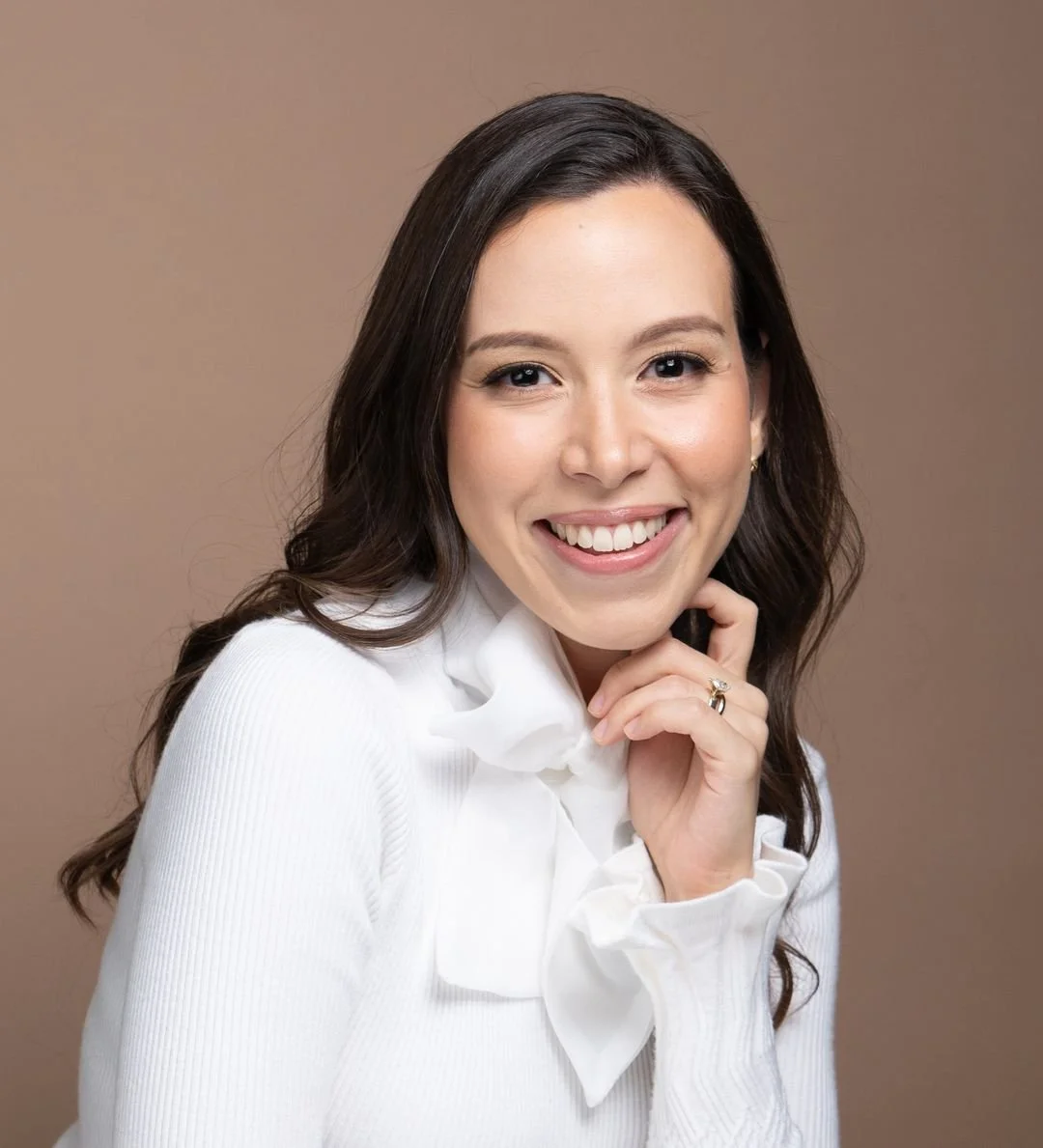
Daniela Blanco is the Co-Founder and CEO of Sunthetics, an AI-driven platform accelerating chemical process development. Trained as a chemical engineer in Venezuela, Daniela grew up surrounded by the oil and chemical industries, which shaped her early understanding of how powerful – yet complex - chemical development can be. She earned her Ph.D. in Chemical Engineering from NYU, where her research centered on redesigning chemical [NB1.1][KD1.2]processes to make them more sustainable. During her doctorate, she began questioning how scientific discoveries actually translate into real-world impact, which led her to NYU’s Entrepreneurial Institute and the formation of Sunthetics after winning the company’s first $100K in funding.
Let’s start with your story. Where are you from, and how did you end up here in Texas?
I’m originally from Venezuela, where the economy is deeply tied to oil and the chemical industry. Growing up, those industries were everywhere—people joked that you either wanted to be Miss Venezuela or a chemical engineer. I chose chemical engineering.
I started my career in oil and gas, which had been a long-term goal, but once I was in it, something didn’t sit right. I was looking for a more sustainable way to contribute to the world, and I wasn’t finding that in my day-to-day work.
That’s what led me to the U.S. in 2017 to pursue a Ph.D. at NYU. My research focused on taking a traditional chemical process and making it more sustainable by powering it with electricity instead of fossil fuels. But as I went deeper into the research, I kept asking myself: What happens after the paper is published? How does this actually make it into the world?
I realized that simply publishing a paper wasn’t enough. That same discomfort I had felt earlier in my career—the gap between doing the work and seeing it make a real-world impact—kept coming back. That curiosity, and that unresolved question of what happens next, is what ultimately led me to Sunthetics.
So you never set out to be a founder?
Not at all. If you had asked me years ago whether I’d run a company, I would have said no. What really drove me was curiosity.
During my doctorate, I started exploring NYU’s Entrepreneurial Institute because it was free and accessible. I entered a pitch competition knowing I didn’t have a business background, fully expecting to lose. Instead, we ended up winning $100K in non-dilutive funding—and I suddenly had to build a company.
In hindsight, not knowing how hard it would be was actually an advantage. That ignorance kept me going. It made me fearless.
What problem did you originally want to solve with Sunthetics—and how has that evolved?
The original goal was to make the chemical industry more sustainable. It’s the 3rd largest contributor to greenhouse gas emissions, largely because chemical reactions rely on heat generated by burning fossil fuels. My initial goal was to electrify those processes, so they could run on renewable energy like solar or wind. But during my Ph.D., it took me three and a half years in the lab just to make one chemical process slightly better. This wouldn't move mountains, and I realized I needed to find a way to multiply my impact.
That’s when it clicked: the industry isn’t unsustainable because people don’t care, it’s unsustainable because R&D is slow and inefficient.
To put it into perspective, innovating in chemistry is like trying to bake a cake without a recipe. You change one ingredient at a time and hope it works. That trial-and-error approach takes years and creates an enormous amount of waste. So, we pivoted Sunthetics toward solving that problem and haven’t looked back.
What does Sunthetics do today?
Sunthetics helps scientists design and optimize chemical processes using small-data AI, particularly in settings where traditional trial-and-error experimentation is slow, expensive, and limiting.
A typical workflow starts with a small number of experiments—often as few as five—which are uploaded into the platform. From this limited dataset, Sunthetics learns how the system behaves and identifies which variables are most informative to explore next. Rather than testing every possible combination, scientists are guided by Sunthetics toward experiments that meaningfully reduce uncertainty. Ultimately, scientists that leverage Sunthetics in their research become significantly faster in R&D, enhancing their understanding of the chemistry while optimizing processes with unprecedented efficiency.
What kind of impact have you seen from this technology so far? Can you quantify what it means for R&D cycles?
We think about impact on three fronts: speed, sustainability, and quality.
First, speed. We help teams move 2-6x faster in R&D. That means more breakthroughs—new materials, better batteries, and faster vaccines. Critical resources can now reach the market in weeks instead of years. If we had that capability during COVID, it’s hard not to think how many lives could have been impacted for the better.
Second, sustainability. Because teams run far fewer experiments, we see up to a 97% reduction in lab waste, emissions, and resource use during R&D. This allows organizations to pursue sustainability goals without compromising scientific rigor or development timelines.
Third, quality. AI doesn’t just make things faster—it makes processes better. We’ve seen our customers uncover more robust and higher-performing process conditions. Our customers have achieved measurable improvements in outcomes such as solar cell efficiency and chemical product performance simply by optimizing how they run their experiments.
How does Sunthetics fit into the traditional scientific method, and does it change how research is done?
That’s a great question. The scientific method itself remains intact: hypotheses are formed, tested experimentally, and refined based on evidence. What changes is how quickly and rigorously that loop can be executed. In many chemical systems, reaching confidence may require 100 or more experiments, largely because it is unclear which variables matter the most. By explicitly modeling uncertainty and guiding experiment selection, teams often reach the same level of understanding in 10 to 15 experiments, while maintaining experimental validation at every step.
Prediction alone is never sufficient. A model is only valuable if its conclusions continue to hold up against real experimental data. The scientist remains accountable for judgment and decision-making, while the AI’s role is to maximize the information gained from each experiment—faster, at lower cost, and with greater precision.
What does talent look like in the future of chemical innovation? Is it Multidisciplinary?
Absolutely. We’re moving into an era where just being a chemist or engineer isn’t enough. In R&D today, you need people who can build bridges across disciplines—chemistry and computer science, materials and AI, statistics and biology. That’s the future. We are seeing this awareness already take-hold at universities, where they are starting to combine coursework across traditionally silo-ed fields.
When I was in grad school, I didn’t even know many of these AI tools existed. Part of what made Sunthetics successful is that we took modeling concepts from other fields and translated it into something relevant for the chemical industry. Now, we are working with universities to integrate our platform into R&D coursework. It is so rewarding to see students get excited by holistic, multidisciplinary perspectives.
I think the next generation of chemists will be a wild and unpredictable mix of programmers, analysts, and system-based thinkers.
Outside of work, what helps you reset?
I’m a big believer in giving yourself permission to disconnect. For me, that means reading fiction, dancing, or playing the piano, which I recently picked back up after a 10-year break! It has become a wonderful reset. People often think hobbies are distractions, but for me they are an integral part of my creative process. It’s my hobbies, like the piano, that help me return to work with a fresh perspective.
What’s a perspective you’d like to leave people with?
I’ve realized that many founders, including myself, spend too much time focusing on the odds against them, instead of accepting uncertainty as part of the process. What we usually see in successful founder stories are polished outcomes, not the years of pivots, missteps, and moments where success felt genuinely uncertain. Every enduring company I’ve studied or learned from was shaped far more by those periods than by any single win.
At the same time, I’ve learned that persistence alone isn’t enough—you also need balance to stay focused. I moved from New York to Austin because I wanted a calmer environment, a stronger sense of community, and the company of my family. This change made me a better leader and a better thinker. Having room to reflect and engage with the parts of life you enjoy helps you lead with more clarity and authenticity.
Ultimately, my mantra has been and remains to be, while it’s ok to ask “what if you fail”, the bigger question is “what if you don’t.”
